Charleston VA hospital promotes early lung cancer screening for long-time smokers
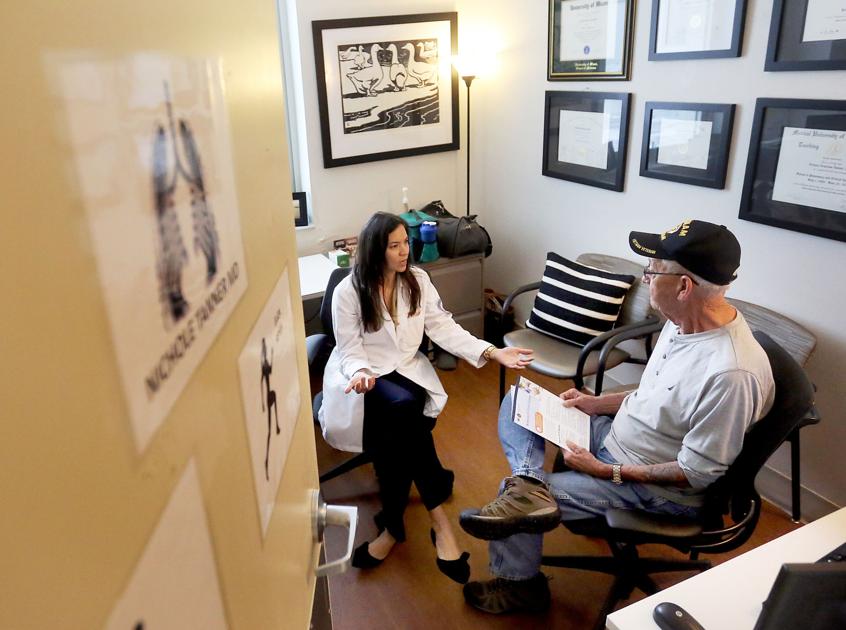
After losing two brothers to lung cancer, Bobby Wilson, a 66-year-old Vietnam veteran, was unknowingly going down a similar path when a spot was found on his lung.
Wilson, who served in the Marine Corps and the Navy in the '70s and '80s, was a prostate cancer survivor who wasn’t showing any physical signs of lung cancer.
Today, because that cancerous spot was found early and removed, Wilson is alive, spending his days walking his demanding Chinese shar-pei named Abby.
“I wouldn’t trade Abby for nothing,” he said.
Wilson, along with many veterans, was a beneficiary of a lung cancer screening program specifically catered to veterans who are heavy cigarette smokers.
The program, which emerged during a time when 75 percent of lung cancer patients were seeking treatment at later and more deadly stages, came as a needed push for earlier diagnoses.
The program specifically involves a variety of medical specialists coming together to detect early signs of the disease, such as spots or nodules on the lung through a CT scan. After that, they make a collective and researched decision whether to surgically remove the spot to prevent further spreading of the disease.
The Ralph H. Johnson Veteran Affairs Medical Center, where Wilson was screened, was one of eight sites across the United States to participate in the pilot screening project in 2013. Because of the program’s success, the project is still on-going.
“By offering our veterans who are at high risk a lung cancer screening, we are finding cancers at an earlier stage when they can be cured,” said Dr. Nichole Tanner, a pulmonologist and critical care doctor with the VA hospital in Charleston.
Though other hospitals outside of the VA have established a lung cancer screening program, Ralph H. Johnson has unique and direct access to patients in their system, which make VA hospitals ideal for the program.
Since its launch, they have screened more than 3,000 veterans and discovered well over 70 lung cancers, most being in the early stage.
“So that’s the benefit and importance of what we are doing,” she said.
Every year, lung cancer kills more people in the United States than breast, colon and prostate cancers combined, she said. That's one reason why, in 2015, Medicare announced it would start covering the cost of low-dose CT scans for beneficiaries with a long smoking history.
But there remains a disconnect among the general population about the severity of the disease.
A reason for this, she believes, has to do with the stigma attached to lung cancer. Wilson and all the other veterans who were a part of the early screening program offered by the VA hospital were either current or former heavy smokers.
Because some view smoking as a form of self-inflicted harm, there isn’t the same level of empathy toward those diagnosed with lung cancer compared to other cancer types, like breast cancer. This stigma has impacted major pushes for funding in the prevention and treatment of lung cancer, Tanner said.
Veterans specifically are twice as likely to be diagnosed with lung cancer largely due to cigarette smoking, she said.
To qualify for the screening program, they cannot have any signs of lung cancer, and must be between the ages of 55 and 80.
Wilson started smoking back in the 1960s when he was 16. When he and his brother, Eddie, who passed away from lung cancer, were serving in Vietnam, Wilson said it was very common for a pack of cigarettes to be included in their sea rations.
“Now, most of the military promotes being a nonsmoker," he said.
Smoking is an addiction and for those who have kept up the habit as long as Wilson has, it can be difficult to break. According to Dr. Tanner, it’s even common for individuals to experience a form of withdrawal when attempting to get rid of the habit.
Though he says he doesn’t smoke nearly as much as he did, quitting the habit is something Wilson himself still hasn’t been able to conquer. He said that it just gives him something to do with his hands.
“When I start running out of things to do, I’ll pick up a cigarette and smoke," he said.
Even though Wilson was able to get the spot on his lung removed, his participation in the screening program doesn't end. According to Tanner, the VA hospital provides continued medical resources to veterans to help them quit the addiction, since an all-clear screening isn't a free pass to continue smoking.
The hope with continuing the program, according to Tanner, is to fight the stigma associated with lung cancer and to continue to raise awareness. Patients need to make the decision to get screened early versus later when they have symptoms, she said.
Ultimately though, she said, that the program's goal will always be centered on helping patients quit.
“Getting people in every year and really pushing for smoking cessation will have far more of a health benefit than any little CT scanner," she said.
https://ift.tt/2OEedji


Comments
Post a Comment