Lung cancer cases in Ireland set to increase substantially over the coming decade - Irish Medical Times
Despite having less smokers, lung cancer cases will increase over the coming decade. Dr Niamh Logan and Dr Parthiban Nadarajan – Department of Respiratory Medicine, St James' Hospital – break down our approach to curbing the disease
Cancer is the leading cause of death in Ireland. Cancer-related deaths accounted for 31% of all deaths in Ireland in 2016, while cardiovascular disease accounted for 30% of all deaths for the same year. Lung cancer remains the leading cause of cancer-related deaths, accounting for 22% and 20% of cancer deaths in males and females respectively.1 This amounts to approximately 2,500 new cases of lung cancer diagnosed each year and approximately 1,800 deaths each year as a consequence of lung cancer.2
In Ireland, lung cancer is the second most common cancer among women (behind breast cancer) and the third most common cancer in men (behind prostate and bowel cancers). The incidence in men is slightly higher, who make up 55% of the diagnosed cases.
However, the incidence of lung cancer among Irish men is still 19% lower than the average incidence among men in the European Union. By contrast, the incidence of lung cancer in Irish women is 55% higher than the European Union average. Although rates of lung cancer remain higher in males, the number of cases observed in females has been increasing steadily – 2% annually compared to a 1% annual decrease in men for the period of 2004-2013 in Ireland.
The National Cancer Control Programme (NCCP) was established in 2007 with the purpose of improving cancer prevention, diagnosis and treatment in Ireland. In 2009 the Rapid Access Lung Clinic (RALC) service was established to streamline the diagnostic pathway for those patients whose presentation was highly suspicious of lung cancer, with the aim that any new patient referred to the RALC would be offered a clinic appointment within 10 working days, and from there, appropriate cases could be prioritised for urgent diagnostic work-up. Further to that, once a diagnosis of lung cancer has been made and diagnostic work-up completed, the goal is that treatment be initiated – within 30 days in the case of surgery, and within 15 days in the case of chemotherapy and radiotherapy.
A report published by NCCP in 2014 established that approximately 30% of those patients attending the RALC were subsequently diagnosed with lung cancer.3
The 5-year survival rates for lung cancer in Ireland was reported as 10.9% between the years 2004 and 2008, compared to 7.8% between 1994 and 1998.4 These figures highlight a modest  improvement in the survival of Irish lung cancer patients over the course of a decade. The 2019 Annual Report from the National Cancer Registry Ireland stated survival has improved significantly to 20%. This substantial improvement in survival rates is comparable to other countries including Canada, Australia, Denmark and Norway.
However, this figure is still significantly lower than other common cancers like colorectal cancer and melanoma, where survival is 63% and 91% respectively. One contributing factor to the high mortality and poor 5-year survival rates in lung cancer is the advanced, inoperable stage of the disease at diagnosis. Approximately 70% of all lung cancers have advanced disease (i.e. stage III and IV) at the time of diagnosis. This late presentation limits treatment options and impacts the patient's prognosis.1
In 1994, 24% of lung cancer cases had metastatic disease at the time of diagnosis, this figure increased to 36.1% by 2016.1 Why is there an increase in metastatic disease? There is a growing interest and focus in staging lung cancer more accurately. Use of PET CT improves the identification of metastatic disease, and is reported to alter management in approximately 20% of lung cancer cases.5
PET CT has only become available in Ireland over the past 15 years and is now a routine part of the evaluation of a patient with lung cancer. Another growing area of interest is accurate staging of mediastinal and hilar lymph node involvement. Mediastinal and hilar lymph node involvement may first be determined based on imaging findings (e.g. CT thorax/PET CT). Pathological confirmation of lymph node involvement is then sought by means of tissue sampling.
Methods of sampling these nodes include; transbronchial lymph node biopsy, mediastinoscopy, VATS and thoracotomy. Each of these sampling techniques have associated challenges; poor sensitivity, time-consuming, invasive, expensive etc. A publication in Thorax in 2003 discussed endobronchial ultrasound guided biopsy (EBUS) of the mediastinal and hilar lymph nodes.6
EBUS has grown significantly in popularity since its introduction, due to its increased sensitivity 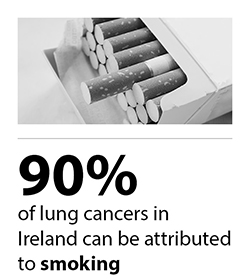 over traditional 'blind' endoscopic methods, and reduced cost and invasiveness in comparison to surgical alternatives. In 2009 when the national cancer centres were established, funding was provided to obtain EBUS equipment for each centre. EBUS is now routinely used in the 8 national cancer centres as part of lung cancer staging.
Despite a trend to more late stage disease at the time of diagnosis, lung cancer survival in Ireland has improved. The focus on accurate staging has contributed to this. Complete staging improves patient prognosis and outcome.5 Many advances have been made in the management of lung cancer which have also had a significant impact on survival.
All cases are discussed at Multi-Disciplinary Team (MDT) meetings, which is attended by cardiothoracic surgeons, pulmonary physicians, medical and radiation oncologists and pathologists, and a management plan is determined based on the specific characteristics of the disease, along with patient performance status and comorbidities. As a general overview, the approach to localised disease is either curative surgical resection or radiotherapy. For those with more advanced disease treatment includes radiotherapy, chemotherapy and immunotherapy.
Numerous advances have been made in the field of medical oncology over the past two decades and specifically in the area of targeted treatments or immunotherapy. Where possible, all those with non-small cell lung cancer undergo molecular testing to assess for mutations which may provide a potential target. Targeted therapies like tyrosine kinase inhibitors (which target EGFR and ALK mutations respectively) have been shown to improve progression-free survival and the quality of life of lung cancer patients.
New technologies continue to emerge in the field of radiation oncology which offer new potential for treatment and aim to reduce associated toxicities. Surgical resection provides the best survival rates for early stage disease in non-small cell lung cancer, but radiotherapy can also provide a curative treatment. Radiotherapy is used as first line in those deemed unfit for surgery or those who decline surgery.
Radiotherapy is of particular interest in elderly patients as it less invasive and can potentially involve only outpatient visits for the duration of the treatment. Patients with severe COPD typically have a higher post-operative mortality.7 These patients have the possibility of curative treatment in the form of radical radiotherapy, thus providing an alternative to high risk surgery.
Lung cancer is a largely preventable disease. Over 90% of lung cancers in Ireland can be attributed to smoking.3 Probably the most crucial part in curbing the incidence of lung cancer in Ireland is to reduce the number of smokers. Currently, 22% of the Irish population are cigarette smokers. There has been a decrease in the number of smokers in Ireland, there are 20.6% less smokers now than there was in 2005. The aim is to have <5% of the population smoking and at the current rate of decline, it will be 2052 before this is achieved.8
Other risk factors for lung cancer include; radon, asbestos and occupational carcinogens.3 Significant efforts have been made to limit the exposure to such carcinogens in the workplace. The Safety, Health and Welfare At Work (Carcinogens) Regulations 2001 were enacted to provide employees and employers across Ireland a standard safe work environment which would limit exposure to any carcinogens.9
Projections for the future show that lung cancer incidence is set to increase – an increase of 58% in women and 77% in men by 2030. Our current figure of 2,500 new cases per year is set to jump to 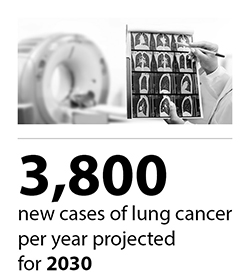 3,800 by 2030. A cost analysis across the European Union has compared the current financial burden of cancer care and this has shown that lung cancer carries the highest financial burden, costing the EU €18.8 billion annually.7
With such a drastic increase in the number of lung cancer cases projected for the future in Ireland, it raises serious concerns about the financial resources required to continue to meet the care needs for these patients. Screening for lung cancer in a high-risk population has also been shown to be beneficial in terms of reducing mortality rates in lung cancer. The National Lung Screening Trial, a large multicentre, randomized controlled trial based in the United States found that annual screening with low-dose CT in a high-risk population was associated with a 20% reduction in lung cancer-specific mortality.10
The more recent Dutch-Belgian NELSON trial confirms the value of low-dose CT screening in people at high risk for developing lung cancer, demonstrating a reduction in mortality by 26% in high-risk men and up to 61% in high-risk women over a 10-year period.
The European Respiratory Society (ERS) now urges countries in Europe to implement screening programmes for lung cancer without delay.
With a rapidly rising incidence of lung cancer in Ireland and a cancer care programme that is striving to keep up with the best international standards of care in lung cancer, there is a mounting pressure on the system to provide rapid diagnostics and treatment.
As outlined above, the staging process is crucial, and each step has significant implications for the overall decision on treatment and patient outcome. With continued emphasis on the integrity and quality of the diagnostic work-up in Irish lung cancer patients we can continue to provide care which is in line with the highest international standards. 
References
-
-
- Cancer In Ireland 1994-2017 With Estimates For 2017-2019: Annual Report Of The National Cancer Registry [Internet]. 2019. Available from: https://www.ncri.ie/sites/ncri/files/pubs/NCRI_Annual_Report_2019_03102019.pdf.
- National Cancer Registry Ireland Incidence Statistics [Internet]. [cited 2019 Oct 10]. Available from: https://www.ncri.ie/data/incidence-statistics.
- Report on the implementation of 'A Strategy for Cancer Control in Ireland 2006' from The National Cancer Control Programme' [Internet]. 2014. Available from: https://www.hse.ie/eng/services/list/5/cancer/pubs/reports/7/year/report.pdf.
- National Cancer Registry Ireland Survival Statistics [Internet]. [cited 2019 Oct 10]. Available from: https://www.ncri.ie/data/survival-statistics.
- Silvestri GA, Gonzalez A V, Jantz MA, Margolis ML, Gould MK, Tanoue LT, et al. Methods for staging non-small cell lung cancer: Diagnosis and management of lung cancer, 3rd ed: American College of Chest Physicians evidence-based clinical practice guidelines. Chest. 2013 May;143(5 Suppl):e211S–e250S.
- Krasnik M, Vilmann P, Larsen SS, Jacobsen GK. Preliminary experience with a new method of endoscopic transbronchial real time ultrasound guided biopsy for diagnosis of mediastinal and hilar lesions. Thorax. 2003 Dec;58(12):1083–6.
- Diagnosis, staging and treatment of patients with lung cancer National Clinical Guideline No. 16 from National Cancer Control Programme [Internet]. 2017. Available from: https://www.hse.ie/eng/services/list/5/cancer/profinfo/guidelines/lung-cancer/nccp-lung-guideline-full.pdf.
- The State of Tobacco Control in Ireland HSE Tobacco Free Ireland Programme, 2018 [Internet]. 2018. Available from: https://www.hse.ie/eng/about/who/tobaccocontrol/tobaccofreeireland/state-of-tobacco-control.pdf.
- Safety, Health and Welfare At Work (Carcinogens) Regulations, 2001. [Internet]. Available from: http://www.irishstatutebook.ie/eli/2001/si/78/made/en/print.
- Aberle DR, Adams AM, Berg CD, Black WC et al. Reduced Lung Cancer Mortality with Low-Dose Computed Tomographic Screening. NEJM 2011; 365(5): 395-409.
-


Comments
Post a Comment