Colorectal Tumors in Adolescents and Young Adults


Stage 4 Breast Cancer Survival Rates And Life Expectancy
Life expectancy for stage 4 breast cancer can vary. Breast cancer that's spread to the lungs, for example, has a five-year survival rate of 10.94%. Other factors that affect life expectancy include age, cancer subtype, tumor size, and treatments.
Stage 4 breast cancer refers to the spread of breast cancer outside the breasts and surrounding lymph nodes. The most common sites of spread include the bones, lungs, liver, and brain. Breast cancer doesn't become bone or lung cancer if it spreads to these body parts. It's still breast cancer.
Stage 4 breast cancer, or metastatic breast cancer, is the most severe and life-threatening type. There's no cure, but treatment can improve survival rates. Read on to learn how long you can live with breast cancer that has metastasized.
There's no cure for stage 4 breast cancer. The main objective of metastatic cancer treatment is instead to extend survival time while opting for therapies with the fewest side effects. The reason is to ensure the best and longest quality of life possible. Some people can respond to treatment for many years or even decades. Others who have a very aggressive form of the disease may have a survival time of less than one year. The five-year survival rate for women with metastatic breast cancer is 29%. Several factors can affect your life expectancy with stage 4 breast cancer, including: Age Hormone receptors and HER2 receptors on cancer cells Locations the cancer has affected Overall health Tumor size People are living longer with stage 4 breast cancer. The number of females living with metastatic breast cancer in the United States is not only increasing. People with the disease are living longer, especially younger adults. Research has found that 11% of women younger than 64 who were diagnosed with stage 4 breast cancer between 2000 and 2004 lived for 10 years or more. Your survival rate with stage 4 breast cancer depends on many variables. You can't control certain variables, such as age and cancer subtype. A healthcare provider can help you control others, like treatment, to improve your survival rate. Age Age can impact survival rates in different ways. People younger than 40 are more likely to have more aggressive types of breast cancer than others. Adults aged 79 and older also have poorer health outcomes than younger adults. Research has shown that the five-year survival rates for the following age groups are: Younger than 40: 42.1% Aged 41 to 60: 32.8% Aged 61 to 80: 28.3% Older than 80: 11.8% Location Metastatic breast cancer is most likely to affect the bones, brain, liver, and lungs. The survival rate can depend on where the cancer cells have spread to: Bone: 39.8% Brain: 1.51% Liver: 7.34% Lungs: 10.94% Cancer Subtype, Tumor Size, and Treatment The type of breast cancer you have can impact life expectancy. About 15% to 20% of people have one type of breast cancer, called HER2-positive, in which the cancer cells produce high levels of HER2. This protein causes tumors to grow rapidly. The five-year survival rates for the following HER2-positive and HER2-negative breast cancers include: HR+/HER2+: 45.6% HR-/HER2+: 39.5% HR+/HER2-: 34% HR-/HER2-: 12.8% Tumor size can also affect survival rates. The survival rate for a primary tumor of 4.8 centimeters (cm) or less is 50%. This rate decreases to 25% for a primary tumor of more than 4.8 cm. Every stage 4 breast cancer diagnosis is different, so the methods used to treat it will also differ. Stage 4 breast cancer is usually treated systemically since the cancer has already spread to other areas of the body. Systemic treatments target the whole body and usually include hormone therapy, chemotherapy, targeted therapy, and immunotherapy. Research has shown that the type of treatment can impact survival rates. Those who receive systemic therapies have a three-year survival rate of 67.9%. Performance Status Performance status (PS) measures how well you can function with breast cancer. PS ranges from a score of 0 to 100. The higher the PS score, the more able you are to take care of yourself. Some evidence suggests that PS can impact life expectancy. The better you can function on your own, the more you may be responding to treatments. The following PS scores are linked to a median survival of: 80 to 100: 221 days 60 to 70: 115 days 40 to 50: 51 days 10 to 30: 22 days It can be difficult to cope with stage 4 breast cancer. You might feel strong anger, denial, and fear. Research has shown that people with metastatic breast cancer often develop anxiety and depression. Having a support system, including family and friends, might improve outcomes. Some evidence suggests that palliative care can prolong life expectancy. The goal of palliative care is to improve the quality of life. Palliative care helps manage symptoms and supports emotional and social health. Newer technologies are also increasingly being used in addition to more standard systemic treatment options. These treatments include ones that sequence the DNA of cancer cells for more specified treatments. Clinical trials are also designed to offer more options and possibly better outcomes to those with stage 4 breast cancer. Stage 4 breast cancer means cancer cells have spread outside the breasts. Life expectancy for stage 4 breast cancer depends on several variables, including age, location, cancer subtype, tumor size, and treatments. Lung metastases, for example, have a five-year survival rate of nearly 11%. A healthcare provider can work with you to determine what treatments best improve your life expectancy. They may recommend building a support group or considering palliative care. These options can help you cope with stage 4 breast cancer.Thanks for your feedback!
Girl Diagnosed With Colon Cancer At 14 After Doctors Dismissed Symptoms For Over 2 Years
Starting in sixth grade, Liberty "Libbie" Ashworth started feeling sick frequently, losing her appetite and experiencing back pain.
"I would get really constipated," Libbie, now 18, of Panora, Iowa, tells TODAY.Com. "There was obviously something going on in my stomach."
By her freshman year, Libbie noticed blood in her stool. She and her parents knew something was seriously wrong. Even though they had visited numerous doctors to understand Libbie's symptoms, doctors dismissed her.
"I was actually told that it's normal for teenage girls to have bouts of blood in their stool," she says. "My mom was not very happy, and we moved to a different (doctor)."
After experiencing intense, sharp abdominal pain and being rushed to the hospital, Libbie received a shocking diagnosis: the then 14-year-old had stage 4 colon cancer.
"It was so frustrating," Tim Ashworth, 52, Libbie's dad, tells TODAY.Com. "They thought we were just bringing her to the doctor too much. We kept saying there's something going on with her."
Stomach troubles, bleeding, back painLibbie dances competitively, and when she first started having back pain, she wondered if it had to do with her rigorous practice and performance schedule. But she had other worrisome symptoms that didn't seem related to dance.
"I didn't feel good," she says. "I actually went and got allergy tested because I didn't have an appetite."
Tests never revealed an underlying cause, and doctors assured Libbie that she was fine. Then, when she was a high school freshman in 2020, "everything went downhill," she says.
Libbie started experiencing "a really upset stomach and really high fever" regularly, and doctors often tested her for COVID, but she was always negative. Then she developed an alarming symptom: blood in her stool. Yet, her doctor dismissed it, attributing it and her pain to Libbie being female and a dancer.
At one point, a doctor even suggested her health issues were psychosomatic.
"It almost broke me because it really hurt having a medical professional that I'm supposed to trust with my life tell me it was in my head," she says. "They actually set me up with a psychiatrist."
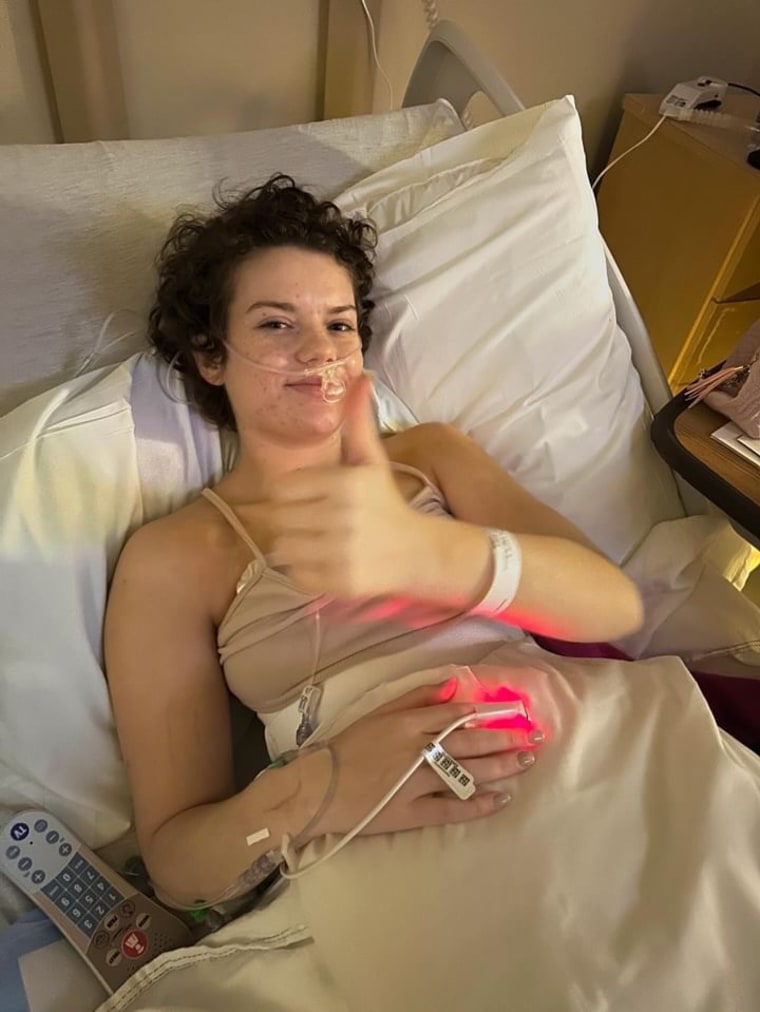 When Libbie Ashworth meets children with cancer she encourages them and gives them advice.Courtesy Libbie Ashworth
 Her parents didn't agree and kept pushing for a colonoscopy.
"Her mom finally called and demanded that they do something, and the new doctor said, 'Yeah we need to get her a colonoscopy,'" Tim Ashworth says. "He finally put the referral in."
But before she could undergo her colonoscopy, Libbie experienced intense cramping.
"I thought I was going to get my period," she says. "It kept getting worse and worse."
Libbie took a bath to try to ease the pain, but it didn't work. Her dad is an EMT and tested her for appendicitis. But that didn't seem to be the problem.
"I was screaming and crying, and I couldn't walk. I couldn't stand," she says. "It was awful."
Her family took her to the nearest emergency room and doctors performed a CT scan.
"They were like, 'Oh, there's actually something in your stomach.' And they didn't know what it was," Libbie recalls. "We did an MRI, and they found this tumor that was grapefruit-sized."
That mass was pressing against her spine, causing two discs to bulge, partially explaining her back pain. The local hospital sent Libbie to a hospital in Des Moines, Iowa. Then on Nov. 10, 2020, the family finally learned why Libbie had been sick.
"(I) got diagnosed with colon cancer," she says. "I was definitely scared."
Libbie had surgery in December 2020, which removed half of her colon, the mass and one of her ovaries to preserve her fertility. Doctors diagnosed her with stage 4 colon cancer. Soon she started chemotherapy at UnityPoint Health — Blank Children's Hospital. She often experienced bad reactions to the chemotherapy.
Libbie's mom, Jennifer Jensen, joined cancer support groups to learn more about colorectal cancer in teens and young adults. She is an outspoken advocate for her daughter and pressed doctors to test Libbie for Lynch syndrome, a genetic disorder that increases a person's chance of developing several types of cancer including colorectal, uterine and liver cancer. Libbie tested positive for Lynch syndrome, even though her parents do not have the mutation.
In February 2021, doctors discovered Libbie had a blockage from the tumors, what's known as a small bowel obstruction, and she was eventually transferred to Mayo Clinic for "a really big surgery," she recalls.
"(I) got the rest of my colon removed and got an ileostomy," Libbie explains.
An ileostomy is an opening in the abdomen that helps remove waste from the body when it's unable to do so normally. Libbie started immunotherapy treatment because it works well with Lynch syndrome colon cancer, Dr. Samantha Mallory, one of her doctors, tells TODAY.Com.
"I was on immunotherapy for about two years, and it actually worked amazingly," Libbie says. "I felt amazing. My hair grew back."
For two years, Libbie had no evidence of disease. Then when she was 17, scans revealed the cancer returned and she needed to start chemotherapy again, and Libbie became intensely ill during.
Jensen did some research and suspected her daughter had a dihydropyridine dehydrogenase (DPD) deficiency. The DPD enzyme helps the liver process chemotherapy, according to the Colorectal Cancer Alliance. Those with a DPD deficiency can't break down the medication, and it builds up, creating dangerous levels in the body. Jensen asked the doctors to test Libbie for it — though Ashworth notes it often took some convincing.
"Jen would bring something up and they would be like, 'Well (Libbie) just can't have that, it's too rare,'" Tim Ashworth recalls. "She would push until Libbie got tested, and then she would always have that."
Ultimately, Libbie learned she had a DPD deficiency and "the chemo was just sitting" in her body," she says.
"I had really bad hand and foot disease. My hair fell out after a day. My legs hurt. My feet hurt so bad I couldn't walk. I had sores all the way down my mouth to my ileostomy," Libbie says. "It was ultimately killing me because of how toxic it was."
Doctors began giving her half the dose of chemotherapy, and the side effects she experienced diminished. The family hoped that new treatments might become available to help Libbie in the future.
Colorectal cancer in teensIn May 2024, doctors presented research that shared some startling numbers. Rates of colorectal cancer in teens have dramatically increased, more than tripling over the past 20 years.
While that sounds scary, the experts say that colorectal cancer teens remains quite rare.
"It went from like one in a million to three in a million, so that's a 300% increase, but it's still a very very small number," Dr. Christina Annunziata, senior vice president of extramural discovery science at the American Cancer Society, tells TODAY.Com. "It's rare, but it's not zero."
 Over the past four years, Libbie underwent three surgeries, chemotherapy, immunotherapy and is in a clinical trial. She continued dancing through it, graduated high school and started college.Courtesy Libbie Ashworth
 Annunziata says that when the "symptoms are pointing towards" colorectal cancer in teens, doctor should consider the diagnosis. Symptoms of colorectal cancer include:
Mallory — a pediatric hematologist and oncologist at Blank Children's who's been involved in Libbie's care — says as colorectal cancer rates increase in younger adults, there have also been more teens being diagnosed with it. Experts believe that diet and a sedentary lifestyle contribute to young onset colorectal cancer in adults and suspect that those factors are at play in teens. Genetic conditions also contribute to colorectal cancer in teens and young adults.
"In Libbie's situation, she's got a genetic syndrome that predisposed her to it," Mallory explains. "We're actually seeing more of that, as well."
Still, Mallory agrees that colorectal cancer in teens is rare, adding, "In pediatrics, it's really not common at all."
Mallory and her colleagues worked closely with adult oncologists to address Libbie's cancer.
"We designed the treatment protocols based on what adults typically get," Mallory says. "She started with some regular old chemotherapy. … She also had to have surgery to remove the big mass that was causing her bleeding."
Once they received the genetic testing results that indicated Lynch syndrome, doctors switched Libbie to immunotherapy, "harnessing her own immune system to attack" the cancer, Mallory explains. Libbie is now in a clinical trial, and if that works, she might not need further treatment for her colorectal cancer.
Due to her Lynch syndrome, though, Libbie will always need to be closely followed.
"She's going to be predisposed to getting all types of cancer and needs surveillance through her entire life to monitor for all the other kinds of cancers," Mallory says.
Despite all the challenges Libbie has faced, she remains positive.
"She's been amazing," Mallory says. "No matter what she goes through, she's still a teenager. We spent two-thirds of our conversation talking about typical teenage stuff and how (cancer) is getting in the way of the stuff she wants to do."
The takeaway for parents is that while stomach pain can be common, "cancer in children is uncommon," Mallory says.
Still, she encourages parents to follow their instincts when it comes to their child's health.
"If there's symptoms that are not going away and you're seeing multiple doctors, (continue) to advocate for further screening," Mallory says.
'The bright side'Since Libbie turned 18, she has qualified for a clinical trial, which uses CRISPR technology to create a personalized treatment to "attack the cancer in my body," she says. CRISPR allows scientists to "selectively modify" DNA, according to the National Human Genome Research Institute.
"The ultimate goal is to cure (her cancer)," Tim Ashworth says. "They just don't know (if it will work) because it's such a new trial."
Throughout her four years with cancer, Libbie has continued to dance and believes her experience can help others. When she meets children with cancer, she tries to encourage and support them.
"I always find the bright side," she says. "Sometimes it's definitely really hard."
Having the support of her family, church and community has helped, though it has been hard to maintain friendships at times. Still, Libbie feels grateful for all the people by her side.
"It's nice knowing you're not fighting alone. No matter what, God has a plan for me," she says. "I can help someone else in the future."
Libbie dances with a team at her college and enjoys spending time with her family. Her ileostomy pouch doesn't stop her from doing most things, including dance, though it can be annoying.
"I'll be changing it, and I'll sit there and cry because it won't stay, it will leak, it will break," she says. "I'll let one small thing get to me, and that's when I'll break down. But then I realize that I'll snap back to reality and change my ileostomy pouch. Everything will be fine."
Her dad says it's hard to watching Libbie face so many challenges.
"The last thing you ever want to see is your kids to have to fight harder than you've ever had to fight," he says. "She also gives me encouragement because … (I) watch this child fight and still have a smile on her face."
 It's been tough for Libbie's family to watch her grapple with colorectal cancer, but they have also felt encouraged by her positive outlook.Courtesy Libbie Ashworth
 Libbie hopes she's showing other people how embrace life while facing adversity.
"Without the cancer, I don't think I'd be who I am today," she says. "I live every day like it's my last, and you never know what happens. I got to look at the bright side."
New Predictors Of Metastasis In Patients With Early-stage Pancreatic Cancer
Researchers at Weill Cornell Medicine with an international team have used liver biopsies to identify cellular and molecular markers that can potentially be used to predict whether and when pancreatic cancer will spread to an individual's liver or elsewhere, such as the lung.
The study, published in Nature Medicine, proposes that information from a liver biopsy—a small tissue sample collected for lab analysis—when pancreatic cancer is diagnosed may help guide doctors in personalizing treatment, such as liver-directed immunotherapies, before cancer cells have the chance to metastasize.
Only 10% of people with pancreatic cancer will survive more than two years after initial diagnosis.
"If we can predict the timing and location of metastases, that could be a real game-changer in treating pancreatic cancer, particularly patients at high metastatic risk," said study co-senior author Dr. David Lyden, the Stavros S. Niarchos Professor in Pediatric Cardiology and professor of pediatrics and of cell and developmental biology at Weill Cornell Medicine.
In 2015, Dr. Lyden and his colleagues discovered that pancreatic cancer cells secrete factors that reach distant organs, most often the liver, to establish a pre-metastatic niche for new tumors to form.
To find out how these alterations prime their new location for cancerous colonization, Dr. Lyden collaborated with lead author Dr. Linda Bojmar, an adjunct assistant professor of molecular biology research in pediatrics at Weill Cornell Medicine and assistant professor of clinical and experimental medicine at Linköping University in Sweden.
Together with researchers at Memorial Sloan Kettering Cancer Center, including co-senior author Dr. William Jarnagin, co-first authors Drs. Constantinos Zambirinis and Jonathan Hernandez, and the hepatopancreatobiliary team, Dr. Lyden and his team obtained liver biopsies from 49 individuals who underwent surgical treatment for early-stage pancreatic cancer. They also collected liver biopsies from 19 people who underwent a similar operation for conditions unrelated to cancer, for example, removal of benign pancreatic cysts.
Liver biopsies reveal early signs of rapid metastasisThe researchers then conducted a battery of molecular, cellular and metabolic analyses on these samples to determine whether they could identify hallmarks that preceded—or potentially prevented—subsequent metastases in the patients. They found that the livers of recurrence-free survivors, who showed no signs of cancer spread after a follow-up period of at least three years, looked much like the livers of people who never had cancer.
At the other end of the spectrum were those who developed liver metastases within six months of diagnosis—a patient group that has poor prognosis with limited therapeutic options. Their livers were riddled with so-called neutrophil extracellular traps (NETs), dense tangles of DNA and enzymes released by dying neutrophils, immune cells that are a first line of defense against infection. Because these NETs are strongly associated with future metastases and develop so early in the course of disease, radiological imaging in the near future may be able to detect them and identify patients in danger of this aggressive spread.
"These individuals could then receive a full course of chemotherapy, or if the metastases are detected when only a few appear, perhaps the secondary tumors could be surgically removed," said Dr. Lyden, who is also a member of the Sandra and Edward Meyer Cancer Center and the Gale and Ira Drukier Institute for Children's Health at Weill Cornell Medicine. In addition, he and his colleagues are investigating whether drugs that digest the DNA that forms the NETs could prevent liver metastases.
Immune responses in later metastasesThe researchers identified two other categories of patients in the study: those who would go on to develop later metastases to the liver and those who would have the cancer spread to other sites, such as the lung. Patients whose cancers spread to organs other than the liver showed a strong immune response fighting the cancer—protective T cells and natural killer cells had infiltrated their livers, and many immune-regulatory genes were activated. These individuals who are prone to developing metastases outside the liver may benefit from immunotherapy to boost their ongoing anti-tumor immune response.
On the flip side, those whose livers succumbed to later metastases also accumulated immune cells—but the cells showed signs of metabolic exhaustion. "It's as if the liver was trying to protect itself, but lost the battle in the end," said Dr. Bojmar.
The researchers plan to validate their findings in a larger cohort of patients with pancreatic cancer and examine whether this approach could be useful with other newly diagnosed cancers.
"We hope to develop a tool for predicting which patients with colorectal cancer will go on to develop liver metastases based on the cellular, molecular and metabolic profiles of their liver biopsies," said co-senior author Dr. Robert Schwartz, associate professor of medicine at Weill Cornell Medicine.
Authors from multiple institutes throughout the United States and in Sweden and Israel contributed to this study.
More information: Multi-parametric atlas of the pre-metastatic liver for prediction of metastatic outcome in early-stage pancreatic cancer, Nature Medicine (2024). DOI: 10.1038/s41591-024-03075-7
Citation: New predictors of metastasis in patients with early-stage pancreatic cancer (2024, June 28) retrieved 28 July 2024 from https://medicalxpress.Com/news/2024-06-predictors-metastasis-patients-early-stage.Html
This document is subject to copyright. Apart from any fair dealing for the purpose of private study or research, no part may be reproduced without the written permission. The content is provided for information purposes only.


Comments
Post a Comment