Bladder Cancer


Life Expectancy With COPD
There's no one-size-fits-all answer when it comes to predicting someone's life span with COPD. A lot depends on your age, health, lifestyle, and how severe the disease was when you were diagnosed, plus the steps you've taken to lessen the damage afterward.
"COPD is a disease with a lot of moving parts," says Albert A. Rizzo, MD, chief medical officer for the American Lung Association. "It's not a death sentence by any means. Many people will live into their 70s, 80s, or 90s with COPD."
But that's more likely, he says, if your case is mild and you don't have other health problems like heart disease or diabetes. Some people die earlier as a result of complications like pneumonia or respiratory failure.
Doctors use a classification system called the Global Initiative on Obstructive Lung Disease (or GOLD) system to determine how severe your COPD is. It's based on how much air you can forcefully exhale in 1 second after blowing into a plastic tube called a spirometer. You'll also hear this called a forced expiratory volume (FEV1) test.
The classifications are based on results for an adult your same age, gender, and ethnic group but without COPD. So if your airflow was 80% of someone's airflow who doesn't have COPD, you'd be at GOLD or Stage 1. There four stages:
In general, the higher your number on the GOLD system, the more likely you are to have problems with or even die from COPD.
Do you have trouble breathing? Have you been hospitalized for COPD flare-ups, which doctors call exacerbations? Doctors look at your symptoms and put you in one of four categories, A-D. The most serious would be GOLD D (high symptom severity and high exacerbation risk).
Smoking is the leading cause of COPD. One study found a small drop in life expectancy (about 1 year) for people with COPD who had never smoked. But there was a much larger reduction for current and former smokers. For men age 65 who smoke, the drop in life expectancy is:
This is in addition to the 3.5 years of life all smokers, whether they have COPD or not, lose to the habit.
The same study also found that women who were current smokers and at Stage 2 lost about 5 years of their lives at Stage 3 and 9 years of their lives at Stage 4.
Another system doctors use to measure life expectancy with COPD is the BODE Index, which stands for:
The higher your BODE score, the greater your risk for death from COPD. This test is considered more accurate than just the FEV1 score.
Right now there aren't any medicines that cure COPD. "We are still looking for drugs that can slow down the disease process itself and reverse inflammation in the airways," Rizzo says. But there are bronchodilators (medications usually taken through inhalers) that can open your airways and improve shortness of breath.
Corticosteroids can help control flare-ups. That's important because more COPD hospitalizations are linked to a higher likelihood of death.
If you're constantly low on oxygen, your doctor might prescribe supplemental oxygen. You'll get a device you can take with you anywhere to help you breathe.
And you have to have access to care in the first place. Rizzo says more studies are looking at COPD in terms of gender, age, and socioeconomic status. Someone with COPD who doesn't have access to health care and doesn't have insurance is more likely to have complications and die early, even if their diagnosis is the same as someone from a higher income level.
An early diagnosis can also greatly improve your life expectancy. "Probably half the people with COPD had the disease for a number of years before they were diagnosed," Rizzo says. "They didn't bring it to the attention of their physician because they thought the cough and the shortness of breath were related to being overweight, out of shape, and still smoking."
Also, doctors have to diagnose COPD correctly by ordering the right tests, he says.
Rizzo also points to studies under way figure out why some people are more likely to get COPD than others. A study started this year by the National Institutes of Health and supported by the American Lung Association will look at lung function in 25-35-year-olds (lung function reaches its peak in the mid-20s) and figure out what changes over the course of their lifetime. "We want to notice when an individual develops findings of COPD, what may have led to it, and what we can learn from that to improve survival," he says.
While there isn't a drug to take care of COPD, there are many lifestyle changes you can make that will slow disease progression and improve your chances of living a longer life. You can:
Once you've been diagnosed with COPD, follow your doctor's advice to stop smoking, exercise, and take any medications prescribed. "And most important, stay active," Rizzo says. "Walking is the best exercise for lungs, so walk on a regular basis."
The Four Stages Of Chronic Obstructive Pulmonary Disease (COPD)
COPD is a progressive lung disease with mild symptoms in the early stages that gradually worsen. Early diagnosis and treatment can help preserve lung function.
People with COPD often have trouble breathing, a persistent cough, and shortness of breath. COPD can be subdivided into stages or grades, depending on how far it has progressed.
It is most common in smokers and people over the age of 40.
Keep reading to learn about the four stages of COPD. We'll discuss the symptoms you can expect at each stage and potential treatment options.
The GOLD system previously classified COPD from stages 1 to 4 solely based on your lung capacity measured by a spirometry test. But the newest GOLD guidelines combine your spirometry results with subjective measures of your symptom severity to determine your level of risk based on their ABCD rubric.
A spirometer test involves exhaling into a machine called a spirometer. The machine measures how hard and quickly you can exhale.
Your doctor examines two numbers in your results: your force vital capacity (FVC) and your force expiratory volume in one second (FEV1). Your FVC is the total amount of air you can breathe out and FEV1 is the amount you breathe out in one second. A ratio of your FEV1/FVC needs to be less than 0.7 for a diagnosis of COPD.
Doctors grade your spirometry results from grade 1 (least severe) to grade 4 (most severe). In the old system, these grades correlate with stage 1 to stage 4 COPD.
Doctors determine the severity of your symptoms using either the British Medical Research Council (mMRC) questionnaire or the COPD Assessment Test (CAT).
Stage 1 COPD is considered mild. At this stage, you may not be aware that you have anything wrong with your lung function. A doctor assigns you with grade 1 COPD if your FEV1 is between 80 and 100% of your predicted value.
Symptoms
If you score grade 1 on your spirometry test, you may not have any noticeable symptoms. If you do have symptoms, you may develop a cough and increased mucus production. You may mistake the early stages of COPD for the flu.
Treatment
Your doctor may also recommend getting flu, COVID-19, and pneumonia vaccines to prevent illnesses that may worsen your respiratory symptoms.
Changing lifestyle habits that led to the development of COPD can potentially help slow the progression of your COPD.
Most people with COPD have a history of smoking. Quitting smoking and avoiding secondhand smoke are two of the most important things you can do to improve your outlook with COPD.
Your COPD is considered to be stage 2 when your FEV1 drops to 50 to 79% of your predicted value.
Symptoms
During stage 2, your symptoms worsen from stage 1. Your coughing and mucus production may become more severe, and you may experience shortness of breath when walking or exercising. Typically, it's in this stage that people realize that something is wrong and seek medical attention from a doctor.
Treatment
You may be given bronchodilator medication to increase airflow to your lungs.
Your doctor may recommend pulmonary rehabilitation, a program designed to increase your awareness about your condition. It's usually offered as a group class where you learn how to manage your condition better.
If you have a flare-up of symptoms, you may need to take steroids or oxygen.
By the time you reach stage 3, COPD is considered severe, and your forced expiratory volume is between 30 to 50 percent of your predicted value. You may have trouble catching your breath doing household chores and may not be able to leave your house.
Symptoms
By stage 3, you may get more frequent flare-ups, and your shortness of breath and coughing typically get worse. You will likely find you get tired easier than before.
Other potential symptoms can include:
Treatment
The treatment options for stage 3 COPD are similar to stage 2. You're more likely to need oxygen therapy at this stage.
Stage 4 is considered very severe. Your forced expiratory volume is less than 30% of your normal value, and your blood oxygen levels are also low. You're at risk of developing COPD complications like heart or lung failure.
Symptoms
By stage 4, you'll likely have frequent flare-ups that can be potentially fatal. You may have trouble breathing even when you're resting.
Treatment
Treatment options during stage 4 are similar to the previous stages. Your doctor may also recommend lung surgery to improve breathing. Surgical options include:
A grade 4 score on your spirometry test is the highest grade you can receive. This category is also sometimes referred to as end stage COPD.
For many people at this stage, quality of life is usually fairly low, and symptom flare-ups can be fatal.
Having COPD lowers your life expectancy. However, the amount that it affects your life expectancy depends on many factors, such as how far your COPD has progressed and whether you quit smoking or change the other lifestyle habits that lead to COPD.
An older 2009 study found that COPD led to a small reduction in life span for people who have never smoked, but a larger life span decrease for people who currently smoke or smoked in the past.
According to the researchers, a 65-year-old man who smokes would lose 3.5 years from their life expectancy for smoking, plus the following values for having COPD:
For former smokers, the reductions are:
For somebody who never smoked, the reductions are:
In a 2017 study, researchers followed a group of long-term smokers with COPD for 5 years. They found that participants who had died before a 5-year follow-up had a longer average smoking time and a lower prevalence of quitting smoking. The researchers concluded that smoking time may be related to COPD mortality rate, and quitting smoking has the largest potential to influence COPD outlook.
A 2020 study of 532 people with COPD at a hospital in Taiwan suggests that loss of life years can vary based on a person's GOLD stage:
This study did not distinguish by smoking history.
No matter how far your COPD has progressed, it's important to change the lifestyle habits that caused your COPD in the first place. The most important thing you can do is quit smoking. If you don't quit, you'll continue to damage your lungs, and your COPD will progress quicker than it would otherwise.
Eating a nutrient-rich eating plan filled with plenty of vegetables, healthy fats, protein, and unprocessed foods may help you manage your symptoms and maintain a healthy weight. Eating foods that cause bloating, like apricots or peaches, may worsen breathing problems in some people.
Regular exercise may help decrease symptoms of COPD by strengthening your respiratory muscles and improving your cardiovascular health. Your doctor may be able to suggest exercise that is safe for you.
COPD (Chronic Obstructive Pulmonary Disease)
Chronic obstructive pulmonary disease (COPD) is a long-term lung condition that makes it hard for you to breathe. COPD is a progressive disease, meaning it gradually gets worse over time.
COPD is an umbrella term used when you have one or more of these conditions:
Emphysema. This results from damage to the small air sacs, called alveoli, inside your lungs. These little sacs transfer oxygen from your lungs to your bloodstream. When they get damaged, their walls break down, leaving larger air spaces in your lungs. These don't work as well to get oxygen into your blood. Also, when you breathe out, trapped air stays in your lungs, leaving less room for fresh air and making you feel short of breath.
Chronic bronchitis. If you have coughing, shortness of breath, and mucus that lingers at least 3 months for 2 years in a row, you have chronic bronchitis. This happens because of irritation of your bronchial tubes, the two large tubes that carry air from your windpipe to your lungs. Hair-like fibers called cilia line these tubes and help move mucus out. When you have chronic bronchitis, you lose your cilia. This makes it harder to get rid of mucus, which makes you cough more, which creates more mucus.
Asthma-COPD overlap syndrome. If you have asthma that doesn't respond to usual treatments along with breathing problems typical of COPD, your doctor may give you this dual diagnosis. Your doctor also might say that your asthma is "refractory" or severe. Most people with asthma do not have COPD.
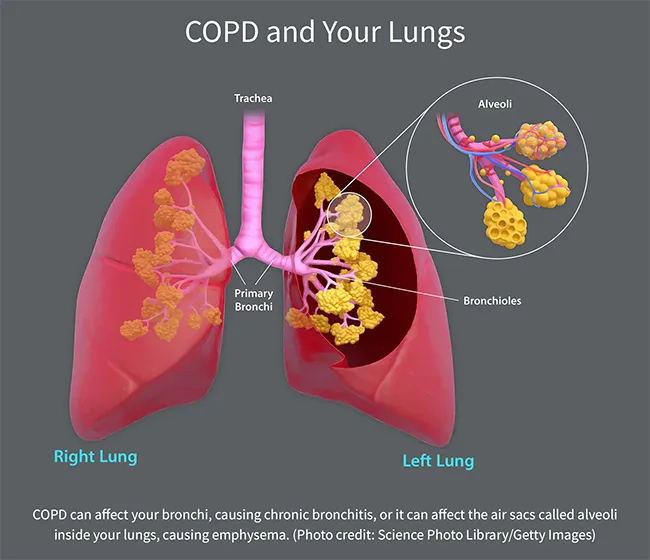
Long-term exposure to things that irritate your lungs is the most common cause. In the U.S., that's cigarette, pipe, or other types of tobacco smoke. Smoking causes about 90% of COPD.
Tobacco smoke triggers irritation and swelling, narrowing your airways. It also damages cilia, so they can't clear mucus as well.
Other causes can include:
You are more likely to develop COPD if you:
At first, you might not have any symptoms. But as the disease gets worse, you might notice these common signs of COPD:
As the disease progresses further, you may also have:
Your doctor will ask about your symptoms, your medical history, and whether you smoke or have been exposed to chemicals, dust, or smoke at work. They'll ask questions like:
They'll also do a physical exam. During the exam, they will:
They'll also order some tests.
The most common test is called spirometry. You'll breathe into a large, flexible tube that's connected to a machine called a spirometer. It'll measure how much air your lungs can hold and how fast you can blow air out of them.
Your doctor may order other tests to see how COPD might be affecting you and to find or rule out other lung problems, such as asthma or heart failure. These might include:
Pulse oximetry. This is a simple test to detect oxygen levels in your blood. It's usually done with a small device clipped to your finger.
Arterial blood gases (ABGs). This uses blood drawn from an artery in your wrist, arm, or groin to check how well your lungs are bringing in oxygen and taking out carbon dioxide.
Chest X-rays. These can help find signs of emphysema, other lung problems, or heart failure.
CT scan. This can create a detailed picture of your lungs. It can tell the doctor if you need surgery or if you have lung cancer.
Electrocardiogram (ECG or EKG). This test checks heart function and can rule out heart disease as a cause of shortness of breath.
Laboratory tests. These can help determine the cause of your symptoms or rule out other conditions, like the genetic disorder alpha-1-antitrypsin (AAT) deficiency.
Exercise testing. You may walk on a treadmill or ride a stationary bike for a few minutes so that your doctor can see how your heart and lungs respond.
Doctors often describe the way COPD progresses in four stages, which you might hear described as GOLD grades. GOLD stands for Global Initiative for Chronic Obstructive Lung Disease. That's a group that sets widely used guidelines for COPD treatment.
These stages are based in part on how badly your airflow is blocked as measured by spirometry, the same test you get when you are diagnosed. In particular, your doctor will look for how much air you can breathe out at one time and how much air you blow out in the first second of a hard exhale.
Your doctor also will consider:
You can expect different symptoms and challenges at each stage.
Stage 1: Mild COPD
You may have no symptoms or feel a little out of breath when you walk upstairs or do moderate exercise. Your airflow is about 80% of normal.
Stage 2: Moderate COPD
You might need to stop and catch your breath when walking on level ground. You may be coughing and wheezing. Your airflow is 50%-79% of normal.
Stage 3: Severe COPD
Your shortness of breath is getting worse and getting in the way of things you want to do every day. Your airflow is 30%-50% of normal.
Stage 4: Very Severe COPD
This is also called end-stage COPD. At this point, it's hard to catch your breath, even when you are sitting or lying down. You may have flare-ups that put you in the hospital and threaten your life. Your airflow is less than 30% of normal.
In addition to these stages, your doctor may put you in a group, labeled A,B,C, or D, based on how likely you are to have flare-ups. This is when your COPD symptoms suddenly get worse. Group A has the lowest risk and group D has the highest.
All of these factors will influence which treatments you try.
There's no cure, so the goal of treatment is to ease your symptoms and slow the disease. Your doctor will also work with you to prevent or treat any complications and improve your overall quality of life.
One of the best things you can do to stop your COPD from getting worse is to stop smoking. Talk to your doctor about ways you can try to quit smoking, even if you've tried many times before.
Medication for COPD
Your plan may include:
COPD surgery
In severe cases of COPD, your doctor may suggest:
Other COPD treatments
Pulmonary rehabilitation. This program includes exercise, nutrition advice, and counseling to help you stay as healthy and active as possible.
Oxygen therapy. As your COPD progresses, you may need extra oxygen while you sleep or do certain activities, or you might need it all the time. Oxygen can reduce shortness of breath, protect your organs, and help you live longer.
In-home noninvasive ventilation therapy. Some people with advanced COPD who have severe trouble breathing out carbon dioxide get a breathing device to use at home. One such device is a bilevel positive airway pressure, or BiPap, machine. You wear a mask or nasal plugs attached to the machine while it helps push air into your lungs.
If you aren't getting enough relief from standard treatments, you might ask your doctor about joining a clinical trial. That's a study in which new treatments are tested, though not everyone in the study may get the treatment. Not everyone is a good fit for a study.
COPD can cause everyday complications, such as:
Inactivity. When you move less because of shortness of breath, that can increase your risk of many other health problems, including loss of bone and muscle, which can make it even harder for you to move around.
Depression and anxiety. Trouble breathing can stop you from doing things you like. And living with a chronic illness can lead to depression and anxiety. Your doctor can help if you feel sad, helpless, or would like to see a mental health professional.
Lost work and income. You may take more sick days and retire earlier than you want because of your symptoms.
Social isolation and loneliness. Your problems with breathing and mobility may keep you away from social gatherings. Loneliness is especially high among those who use supplemental oxygen.
Confusion and memory loss. Your chronic problems breathing in enough oxygen and breathing out enough carbon dioxide can affect your thinking abilities. Smoking can make those effects worse.
COPD is also linked with increases in many other health problems, like:
Respiratory infections. COPD can raise your chances of getting colds, the flu, and pneumonia. They make it harder for you to breathe and could cause more lung damage. Infections also can trigger COPD flare-ups. Staying up to date on all vaccines can help.
Heart problems. Doctors aren't sure why, but COPD can raise your risk of heart disease, including heart attack. Quitting smoking may lower the odds.
Lung cancer. People with COPD are more likely to get lung cancer. Quitting smoking can help.
High blood pressure in lung arteries. COPD may raise blood pressure in the arteries that bring blood to your lungs. Your doctor will call this pulmonary hypertension.
Though there's no cure, there are things you can do to stay healthy and ease your symptoms. Try taking these steps to enhance your quality of life:
There may be times when your symptoms get worse for days or weeks. You might notice you're coughing more with more mucus, have more trouble breathing, are struggling more to sleep, and feel worse. Your doctor will call this an acute exacerbation or a flare-up. If you don't treat it, it could lead to lung failure.
Make sure you talk to your doctor about what to do when you notice a flare-up starting. You might need to take extra medicines or take other steps to keep symptoms under control.
Your doctor might prescribe antibiotics if you have a bacterial infection or steroids to tamp down inflammation. Or you might need oxygen treatments. In some cases, you'll need to go to the hospital. When you're better, talk with your doctor about how to lower the risk of flare-ups. They may recommend you renew efforts to quit smoking and avoid triggers like exposure to secondhand smoke, dust, pollen, and germs. You might also add daily medications to improve symptom control.
You can improve life with COPD by taking part in the management of your condition. One way to help your doctor is to monitor your COPD symptoms, diet, and exercise daily.
Keeping a daily written log may help you recognize a COPD exacerbation when it begins. With a log, you're more likely to notice when COPD symptoms suddenly get worse. This may allow you to seek medical treatment early, when it's most effective, and might keep you from having to go to the hospital.
It is also important to follow a healthy, balanced diet to prevent being overweight, which can make shortness of breath worse, or underweight, which is linked to a poorer outcome. Your doctor or a nutritionist can suggest healthy food choices for you.
Use your log to track these things each day:
Get medical help right away if any of these things happen:
COPD makes it hard for you to breathe and tends to get worse over time. But there are lots of things you can do to slow it down and feel better. Work with your doctor to come up with a management plan that gives you the best quality of life possible.
What is the life expectancy for a person with COPD?
The exact amount of time you can live with COPD depends on your age, overall health, and symptoms. If you have mild, well-managed COPD, you might live for 10 or 20 years after your diagnosis. Your life expectancy is shorter if you have severe COPD, which takes an estimated 8-9 years off an average person's life. Life expectancy is shorter at any stage if you smoke
How does a person with COPD feel?
When you have COPD, it can feel like breathing takes more effort and you are gasping for air, especially when you are active. Your chest might feel tight and heavy. You might feel tired all the time.
Can I live a normal life with COPD?
Many people can live an active life with COPD. The key is follow your doctor's recommendations for managing your condition, with medications, a healthy lifestyle, and other supports, such as pulmonary rehabilitation. Joining a COPD patient support group could help as well.


Comments
Post a Comment